

Otto Weidt
died 1947-12-22, Berlin

Otto Weidt was born in Rostock in 1883, and grew up in poverty. In 1888 his family moved to Berlin, where Otto Weidt trained as a painter and gilder. He was active in anarchist circles in his youth, a conviction he maintained for his entire life, referring to himself as an “individualist anarchist.” In 1936 he married his third wife, Else Nast, born 1902.
After going almost entirely blind, Otto Weidt became a brush maker and in 1939 opened Otto Weidt’s Workshop for the Blind along with his business partner Gustav Kremmert. From 1940 the workshop was located at Rosenthaler Straße 39.
Otto Weidt was a determined opponent of National Socialism. He employed mainly Jewish workers. He did everything he could to make their lives easier under the National Socialist regime. When he was no longer able to prevent their deportation through deception and bribery, he arranged hiding places for some of them. A number of people managed to survive thanks to his help. Otto Weidt died in December 1947 at the age of 64.
Dokumente
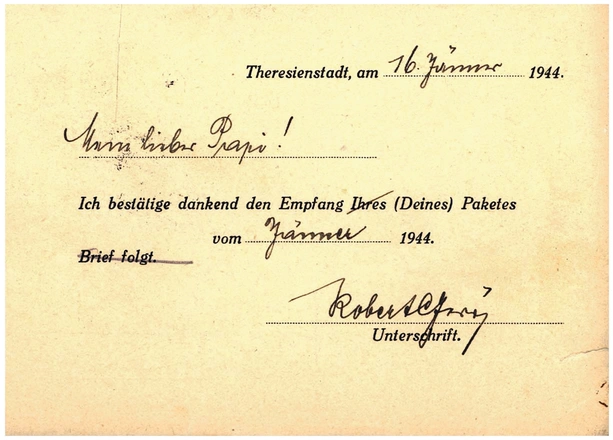
Robert Gerö to Otto Weidt, January 16, 1944Inhalt: Robert Gerö was one of the Jews in Vienna’s “Special Service” who came to Berlin with Alois Brunner in mid-November 1942, after many officers had to resign from Berlin’s Gestapo headquarters after an embezzlement scandal. At the workshop for the blind, he met Otto Weidt, Alice Licht, and Inge Deutschkron several times, helping the workshop by warning of raids and deportations. However, he was no longer able to protect them from mid-January 1943, whereupon the Lichts and the Deutschkrons went underground. Robert Gerö presumably spent only 27 days in Berlin.Umschrift: Theresienstadt, January 16, 1944. My dear Pappi, I confirm with thanks the receipt of your package dated January 1944. Robert Gerö Signature. Source: Stiftung Neue Synagoge Berlin – Centrum Judaicum
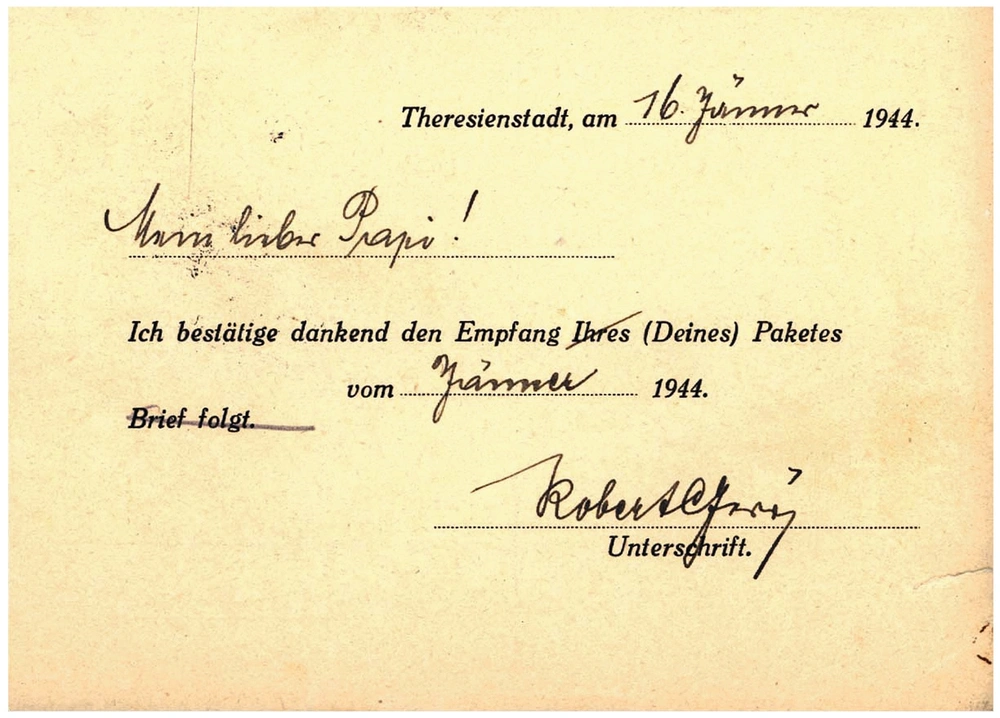
Robert Gerö to Otto Weidt, January 16, 1944Inhalt: Robert Gerö was one of the Jews in Vienna’s “Special Service” who came to Berlin with Alois Brunner in mid-November 1942, after many officers had to resign from Berlin’s Gestapo headquarters after an embezzlement scandal. At the workshop for the blind, he met Otto Weidt, Alice Licht, and Inge Deutschkron several times, helping the workshop by warning of raids and deportations. However, he was no longer able to protect them from mid-January 1943, whereupon the Lichts and the Deutschkrons went underground. Robert Gerö presumably spent only 27 days in Berlin.Umschrift: Theresienstadt, January 16, 1944. My dear Pappi, I confirm with thanks the receipt of your package dated January 1944. Robert Gerö Signature. Source: Stiftung Neue Synagoge Berlin – Centrum Judaicum
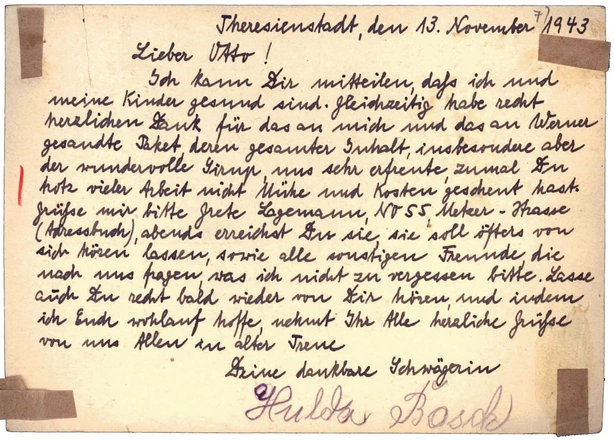
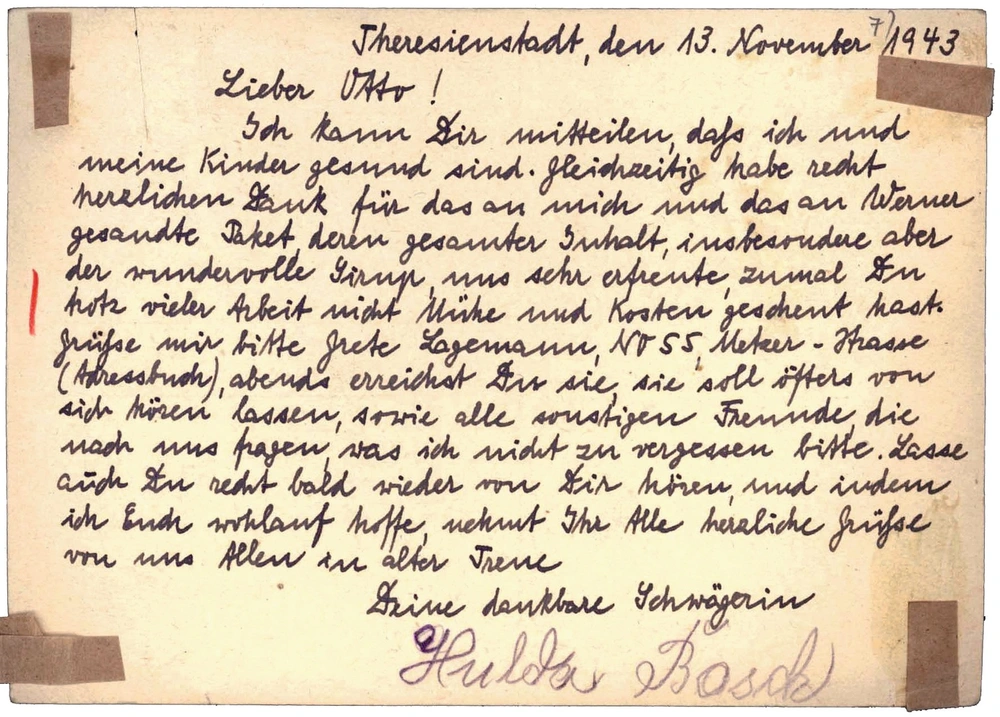
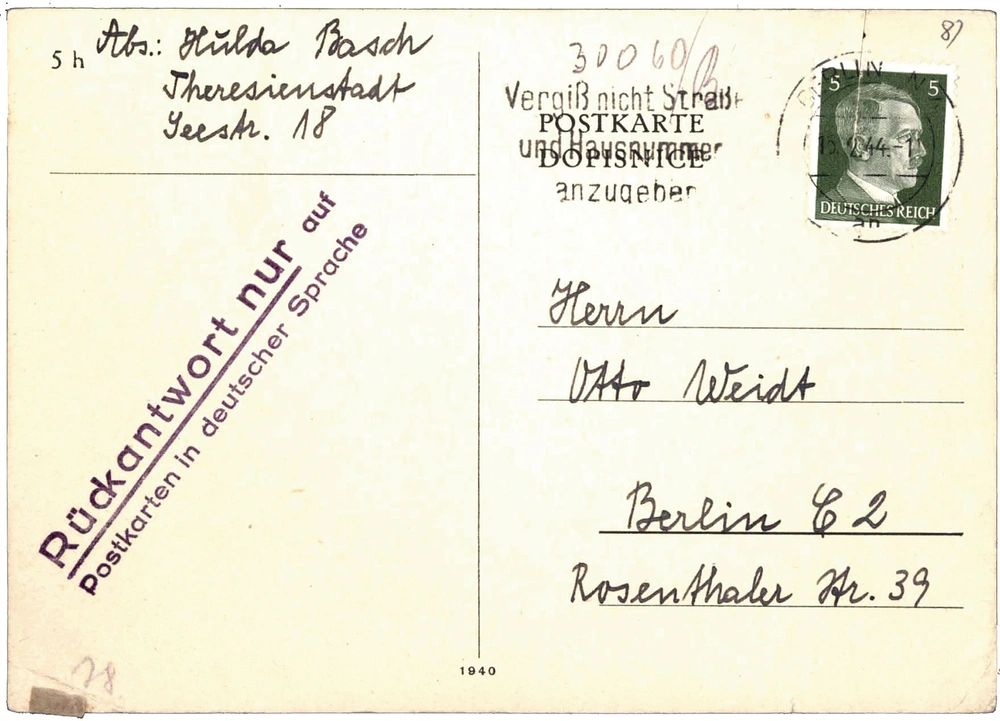
Hulda Basch to Otto Weidt, November 13, 1943Inhalt: Born in Marggrabowa in East Prussia in 1883, Hulda Basch, née Leffkowitz, was deported from Berlin to Theresienstadt with the third large transport of elderly people on October 3, 1942. She did not write her first card until thirteen months later. Since her daughter-in-law Ilse Basch called herself Otto Weidt’s “niece” and Werner Basch his “nephew” as cover in the postcards, she refers to herself for the same reason as his “sister-in-law.” Hulda Basch thanks Otto Weidt for the “wonderful syrup,” which he had been able to buy from a sales representative at the nearby Monbijou Park. He not only sent it to Theresienstadt but also distributed it to the Jews working in his workshop. This censored postcard—evidenced by the penciled number “18” on the bottom left of the address side—took three months to arrive. It was not postmarked until February 15, 1944, in Berlin N 4, at the post office at Stettiner Bahnhof station (now Nordbahnhof). Hulda Basch died in Theresienstadt at the age of 61 on April 26, 1944.Umschrift: Theresienstadt, November 13, 1943. Dear Otto, I can inform you that my children and I are healthy. Simultaneously, many thanks for the package sent to me and Werner. We were delighted with its entire contents, particularly the wonderful syrup, especially as you spared neither effort nor cost, despite all your work. Please send my greetings to Grete Lagemann, NO 55, Metzer-Straße (address book), you will reach her in the evening, tell her to contact us more often, and to all other friends who ask after us, which I ask you not to forget. Please write again soon yourself, and as I hope you are all well, please all of you accept affectionate greetings from all of us in old loyalty your grateful sister-in-law Hulda Basch Source: Yad Vashem, Jerusalem
Hulda Basch to Otto Weidt, November 13, 1943Inhalt: Born in Marggrabowa in East Prussia in 1883, Hulda Basch, née Leffkowitz, was deported from Berlin to Theresienstadt with the third large transport of elderly people on October 3, 1942. She did not write her first card until thirteen months later. Since her daughter-in-law Ilse Basch called herself Otto Weidt’s “niece” and Werner Basch his “nephew” as cover in the postcards, she refers to herself for the same reason as his “sister-in-law.” Hulda Basch thanks Otto Weidt for the “wonderful syrup,” which he had been able to buy from a sales representative at the nearby Monbijou Park. He not only sent it to Theresienstadt but also distributed it to the Jews working in his workshop. This censored postcard—evidenced by the penciled number “18” on the bottom left of the address side—took three months to arrive. It was not postmarked until February 15, 1944, in Berlin N 4, at the post office at Stettiner Bahnhof station (now Nordbahnhof). Hulda Basch died in Theresienstadt at the age of 61 on April 26, 1944.Umschrift: Theresienstadt, November 13, 1943. Dear Otto, I can inform you that my children and I are healthy. Simultaneously, many thanks for the package sent to me and Werner. We were delighted with its entire contents, particularly the wonderful syrup, especially as you spared neither effort nor cost, despite all your work. Please send my greetings to Grete Lagemann, NO 55, Metzer-Straße (address book), you will reach her in the evening, tell her to contact us more often, and to all other friends who ask after us, which I ask you not to forget. Please write again soon yourself, and as I hope you are all well, please all of you accept affectionate greetings from all of us in old loyalty your grateful sister-in-law Hulda Basch Source: Yad Vashem, Jerusalem
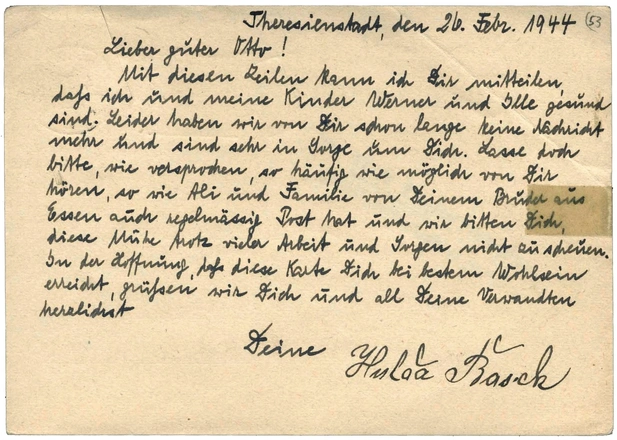
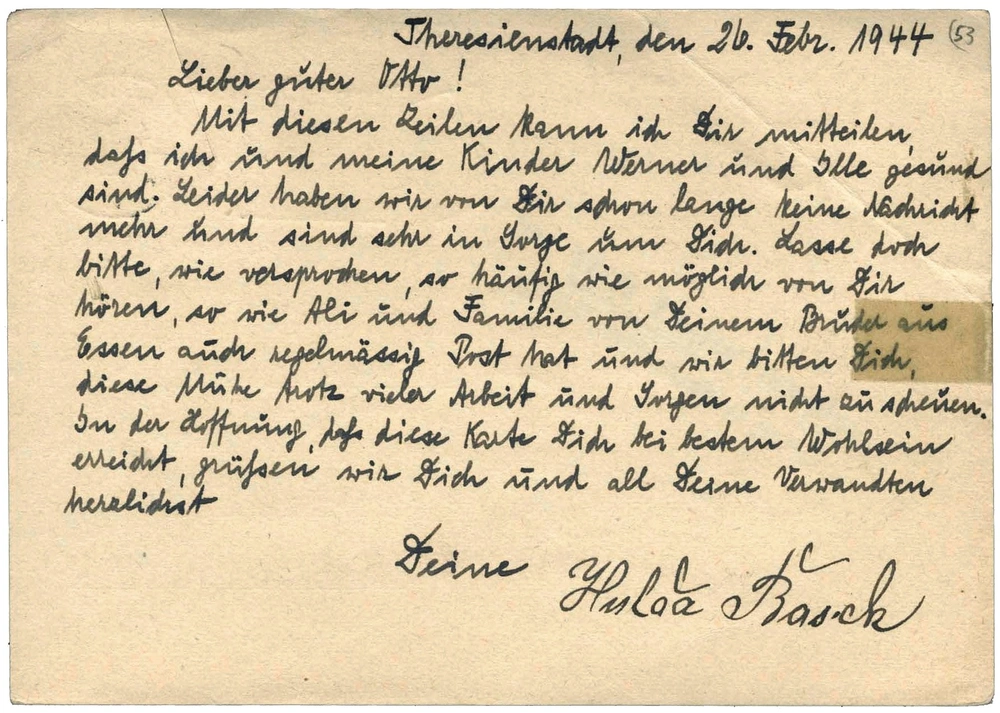
Hulda Basch to Otto Weidt, February 26, 1944Inhalt: Werner Basch used his mother Hulda Basch’s quarterly writing permission to emphasize that the three Baschs were urgently hoping for more “love gift packages.” Otto Weidt did not have a brother in Essen, but the city’s name also means “food.” The message is that Hulda, Ilse, and Werner Basch are waiting for food in Theresienstadt. By the time this card was postmarked in Berlin-Charlottenburg 2 on May 4, 1944, Hulda Basch had been dead for eight days. She died in Theresienstadt at the age of 61 on April 26, 1944.Umschrift: Theresienstadt, Febr. 26, 1944. Dear, kind Otto, With these lines, I can inform you that I and my children Werner and Ille [Ilse] are healthy. Sadly, we have not received any message from you for a long time and are very concerned about you. Please write to us, as promised, as often as possible, just as Ali [Alice Licht] and family regularly get mail from your brother in Essen and we ask you not to spare this effort despite all your work and worries. In the hope that this card will find you in the best of health, we send affectionate greetings to you and all your relatives Yours, Hulda Basch Source: Yad Vashem, Jerusalem
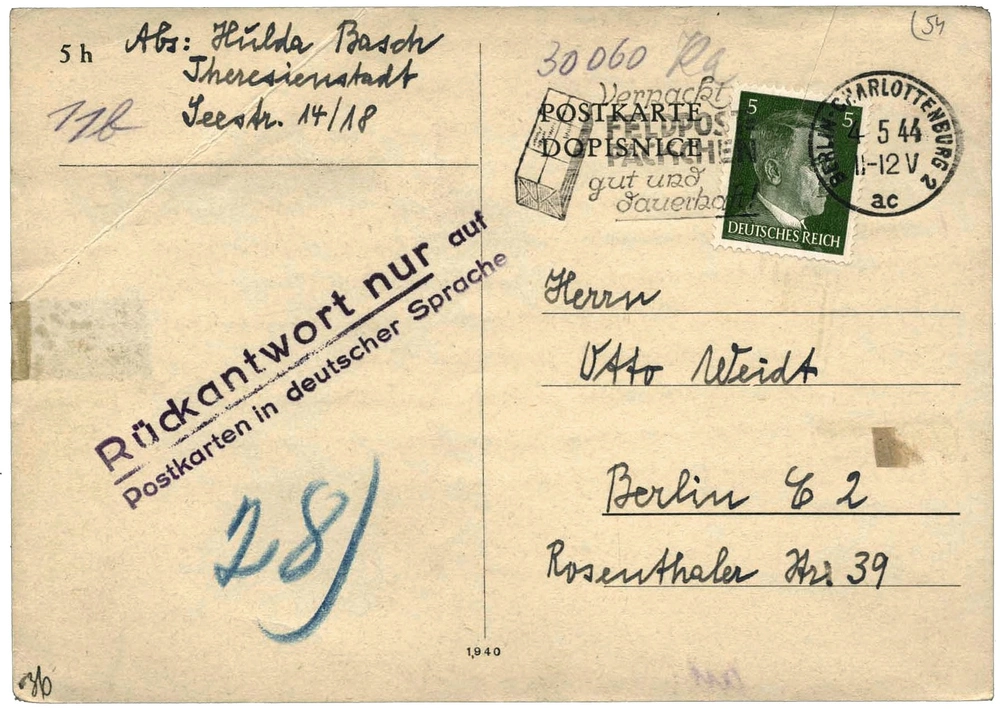
Hulda Basch to Otto Weidt, February 26, 1944Inhalt: Werner Basch used his mother Hulda Basch’s quarterly writing permission to emphasize that the three Baschs were urgently hoping for more “love gift packages.” Otto Weidt did not have a brother in Essen, but the city’s name also means “food.” The message is that Hulda, Ilse, and Werner Basch are waiting for food in Theresienstadt. By the time this card was postmarked in Berlin-Charlottenburg 2 on May 4, 1944, Hulda Basch had been dead for eight days. She died in Theresienstadt at the age of 61 on April 26, 1944.Umschrift: Theresienstadt, Febr. 26, 1944. Dear, kind Otto, With these lines, I can inform you that I and my children Werner and Ille [Ilse] are healthy. Sadly, we have not received any message from you for a long time and are very concerned about you. Please write to us, as promised, as often as possible, just as Ali [Alice Licht] and family regularly get mail from your brother in Essen and we ask you not to spare this effort despite all your work and worries. In the hope that this card will find you in the best of health, we send affectionate greetings to you and all your relatives Yours, Hulda Basch Source: Yad Vashem, Jerusalem


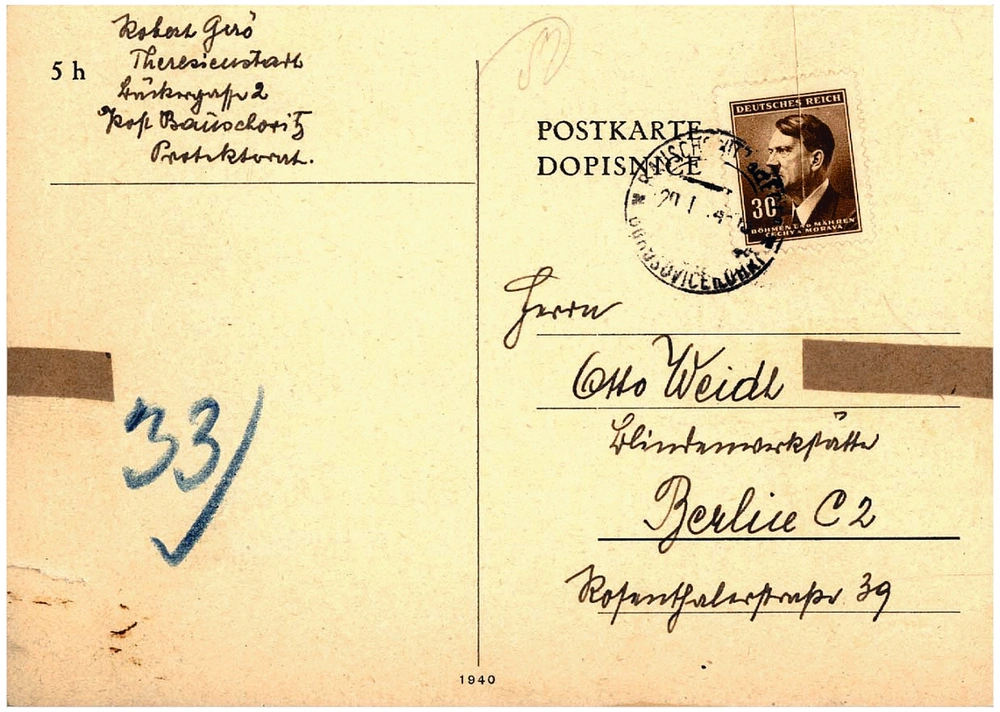
Werner Basch to Otto Weidt, December 30, 1943Inhalt: With this card written on the second-last day of 1943, Werner Basch confirms a package sent from Berlin by Otto Weidt on December 15. At this point, 34,655 prisoners were living in the Theresienstadt ghetto, including almost 3,400 children. This card was given a 30-heller postage stamp at the Bauschowitz post office. The date of the postmark is January 13, 1944.Umschrift: Theresienstadt, December 30, 1943. Dear Uncle Otto, I confirm with thanks the receipt of your package dated December 15, 1943. Werner Basch Signature.

Werner Basch to Otto Weidt, December 30, 1943Inhalt: With this card written on the second-last day of 1943, Werner Basch confirms a package sent from Berlin by Otto Weidt on December 15. At this point, 34,655 prisoners were living in the Theresienstadt ghetto, including almost 3,400 children. This card was given a 30-heller postage stamp at the Bauschowitz post office. The date of the postmark is January 13, 1944.Umschrift: Theresienstadt, December 30, 1943. Dear Uncle Otto, I confirm with thanks the receipt of your package dated December 15, 1943. Werner Basch Signature.


Werner Basch to Otto Weidt, January 20, 1944Inhalt: From May 1943, prisoners were only allowed to send one postcard every three months. Due to the increased number of prisoners, the postcards were issued by the block elders or building elders. Werner Basch, who uses the “uncle-nephew” connection here only for appearances, used his permission to write in January 1944 to ask Otto Weidt emphatically for packages. His comment that he had not heard from him for months may be true, since the last known confirmation card is dated December 30, 1943. This postcard was censored, as evidenced by the penciled “26” on the bottom left of the back. It arrived in Berlin at the Reich Association of Jews in Germany, which franked it and stamped it “Return answer on postcards in German language only.” A staff member posted it in the Berlin-Charlottenburg 2 district.Umschrift: Theresienstadt, January 20, 1944. Dear Uncle Otto, I trust you are in receipt of my various cards and can inform you with these lines that my family and I are healthy, which I hope also goes for you. Sadly, I have not heard from you for months, while I know that Ali regularly receives post from you. I am very distressed by this fact, since I can think of no reason why you have forgotten me entirely, or is the mail to Ali and family always intended for me too? In any case, I would be very pleased to hear directly from you instead, as far as your time and worries allow. For today, I remain with heartfelt regards from us all Your nephew Werner Basch Source: Yad Vashem, Jerusalem

Werner Basch to Otto Weidt, January 20, 1944Inhalt: From May 1943, prisoners were only allowed to send one postcard every three months. Due to the increased number of prisoners, the postcards were issued by the block elders or building elders. Werner Basch, who uses the “uncle-nephew” connection here only for appearances, used his permission to write in January 1944 to ask Otto Weidt emphatically for packages. His comment that he had not heard from him for months may be true, since the last known confirmation card is dated December 30, 1943. This postcard was censored, as evidenced by the penciled “26” on the bottom left of the back. It arrived in Berlin at the Reich Association of Jews in Germany, which franked it and stamped it “Return answer on postcards in German language only.” A staff member posted it in the Berlin-Charlottenburg 2 district.Umschrift: Theresienstadt, January 20, 1944. Dear Uncle Otto, I trust you are in receipt of my various cards and can inform you with these lines that my family and I are healthy, which I hope also goes for you. Sadly, I have not heard from you for months, while I know that Ali regularly receives post from you. I am very distressed by this fact, since I can think of no reason why you have forgotten me entirely, or is the mail to Ali and family always intended for me too? In any case, I would be very pleased to hear directly from you instead, as far as your time and worries allow. For today, I remain with heartfelt regards from us all Your nephew Werner Basch Source: Yad Vashem, Jerusalem
Robert Gerö to Otto Weidt, January 16, 1944Inhalt: After an embezzlement scandal in Berlin’s Gestapo headquarters, many officers had to step down. In mid-November 1942, Alois Brunner and other Gestapo functionaries from Vienna were sent to complete the deportations from Berlin. They brought with them three Jewish men who had worked for the Vienna “Special Service” on deportations. One of these three Viennese Jews was Robert Gerö, born in Leobersdorf near Vienna in 1904. Alice Licht presumably met him between September 1939 and August 1940, when she made several trips to Vienna on behalf of the Aid Association of Jews in Germany. After Gerö’s arrival in Berlin, she immediately made contact with him. At the workshop for the blind, he met Otto Weidt, Alice Licht, and Inge Deutschkron on several occasions. He promised to delay the Licht and Deutschkron families’ deportations for as long as possible. In mid-January 1943, however, he had to inform both women that he could no longer protect them. Alice Licht and her parents went into hiding at Neanderstraße 12, while Inge Deutschkron and her mother hid with friends.Umschrift: Theresienstadt, January 16, 1944. My dear Pappi, I confirm with thanks the receipt of your package dated January 1944. Robert Gerö Signature.
Robert Gerö to Otto Weidt, January 16, 1944Inhalt: After an embezzlement scandal in Berlin’s Gestapo headquarters, many officers had to step down. In mid-November 1942, Alois Brunner and other Gestapo functionaries from Vienna were sent to complete the deportations from Berlin. They brought with them three Jewish men who had worked for the Vienna “Special Service” on deportations. One of these three Viennese Jews was Robert Gerö, born in Leobersdorf near Vienna in 1904. Alice Licht presumably met him between September 1939 and August 1940, when she made several trips to Vienna on behalf of the Aid Association of Jews in Germany. After Gerö’s arrival in Berlin, she immediately made contact with him. At the workshop for the blind, he met Otto Weidt, Alice Licht, and Inge Deutschkron on several occasions. He promised to delay the Licht and Deutschkron families’ deportations for as long as possible. In mid-January 1943, however, he had to inform both women that he could no longer protect them. Alice Licht and her parents went into hiding at Neanderstraße 12, while Inge Deutschkron and her mother hid with friends.Umschrift: Theresienstadt, January 16, 1944. My dear Pappi, I confirm with thanks the receipt of your package dated January 1944. Robert Gerö Signature.
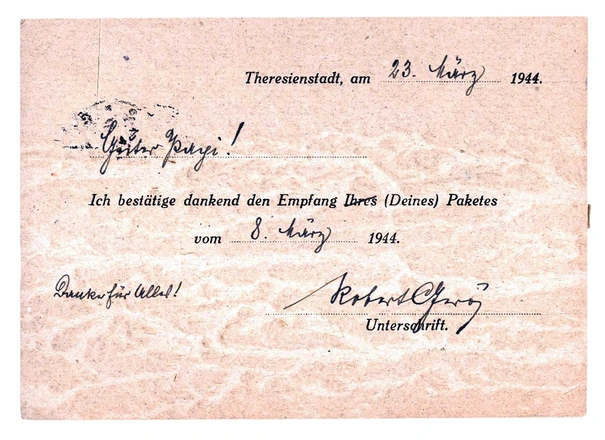
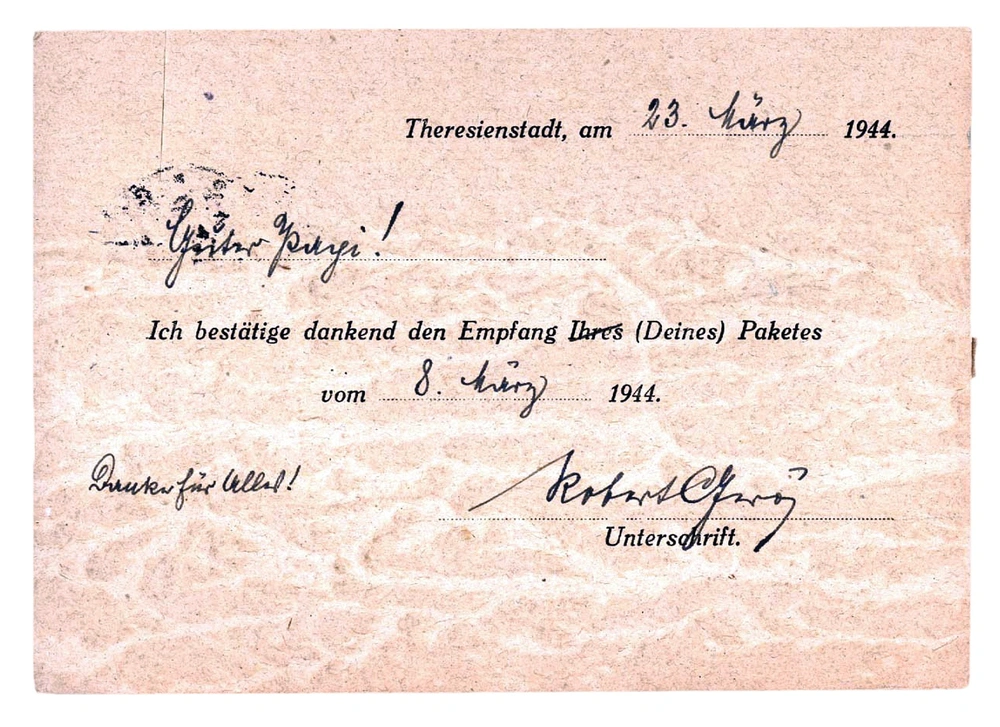
Robert Gerö to Otto Weidt, March 23, 1944Inhalt: At the end of January 1943, Alois Brunner left Berlin to coordinate the deportation of more than 45,000 Jews from Saloniki in Greece to the extermination camps. Robert Gerö had to return to Vienna, was himself deported to Theresienstadt on April 2, 1943, and then transferred to Auschwitz eighteen months later, on September 29, 1944. Classed as “capable of labor,” he was sent first to Sachsenhausen concentration camp, then to Mauthausen, where he was liberated. He later emigrated to Argentina. On the surviving cards, Robert Gerö calls Otto Weidt “My dear Pappi” and “Kind Pappi.” This may have corresponded to his personal feelings, since he had received a warm and friendly reception at the workshop for the blind—presumably out of calculation—despite his function stewarding the deportations. Alice Licht wrote to Gustav Held from Theresienstadt on April 28, 1944: “Robert has proved a good friend here too…”Umschrift: Theresienstadt, March 23, 1944. Kind Pappi, I confirm with thanks the receipt of your package dated March 8, 1944 “Thank you for everything!” Robert Gerö Signature.
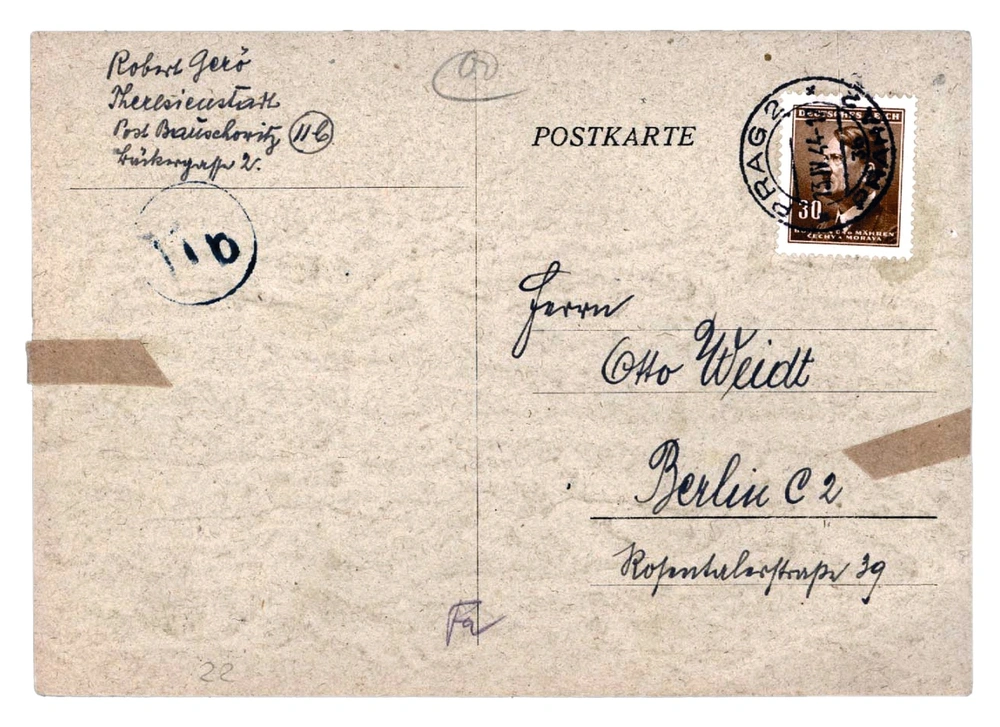
Robert Gerö to Otto Weidt, March 23, 1944Inhalt: At the end of January 1943, Alois Brunner left Berlin to coordinate the deportation of more than 45,000 Jews from Saloniki in Greece to the extermination camps. Robert Gerö had to return to Vienna, was himself deported to Theresienstadt on April 2, 1943, and then transferred to Auschwitz eighteen months later, on September 29, 1944. Classed as “capable of labor,” he was sent first to Sachsenhausen concentration camp, then to Mauthausen, where he was liberated. He later emigrated to Argentina. On the surviving cards, Robert Gerö calls Otto Weidt “My dear Pappi” and “Kind Pappi.” This may have corresponded to his personal feelings, since he had received a warm and friendly reception at the workshop for the blind—presumably out of calculation—despite his function stewarding the deportations. Alice Licht wrote to Gustav Held from Theresienstadt on April 28, 1944: “Robert has proved a good friend here too…”Umschrift: Theresienstadt, March 23, 1944. Kind Pappi, I confirm with thanks the receipt of your package dated March 8, 1944 “Thank you for everything!” Robert Gerö Signature.
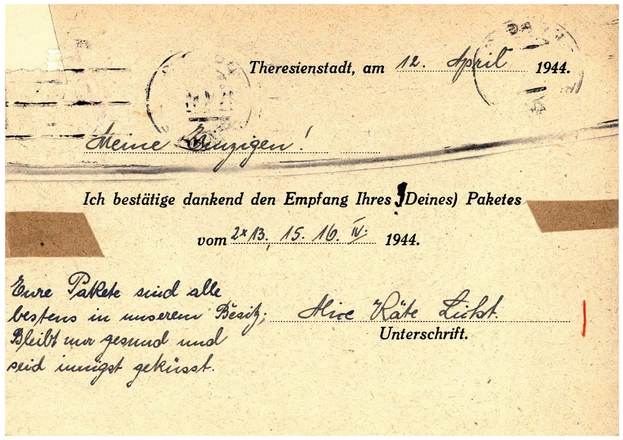
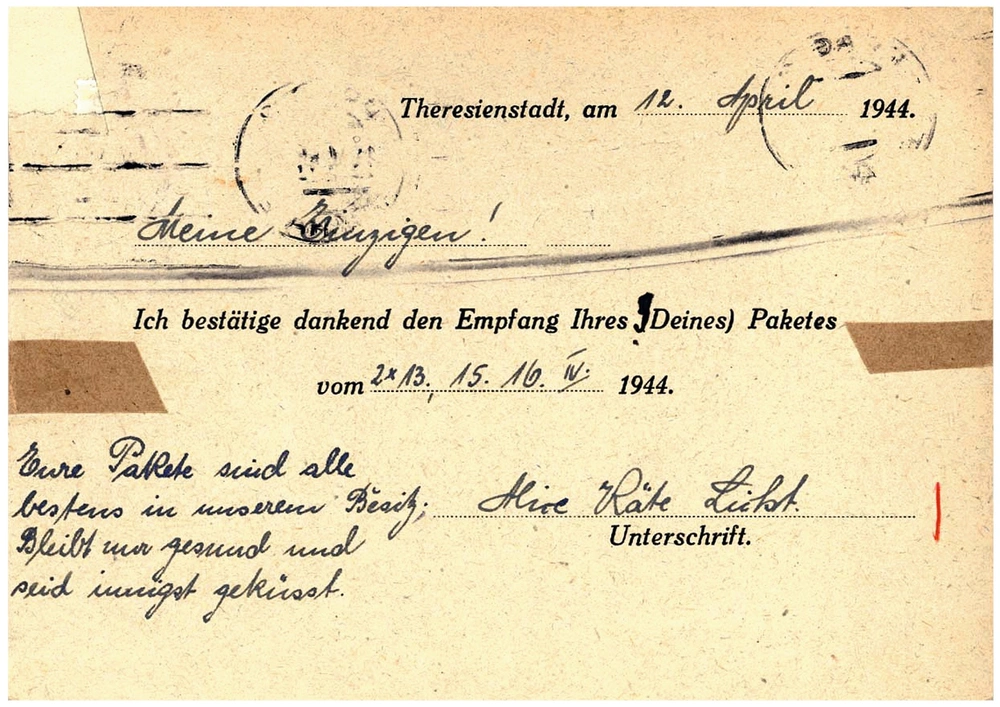
Alice Käte Licht to Bootsch c/o Otto Weidt, April 12, 1944Inhalt: Alice Licht confirms two packages from April 13 and one each from April 15 and 16, 1944, to a “Mrs. Bootsch” not known to us today. The date on the card is rather strange: April 12, 1944, actually before the receipt of the packages. Alice Licht presumably meant April 21 or 22. Alice Licht adds her mother’s first name Käthe to her own name as a greeting and sign of life. This censored card – the censor has left a “30” on the address side – was not postmarked until four weeks later, on May 11, 1944, at the post office in the Prague 2 district.Umschrift: Theresienstadt, April 12, 1944. My only ones, I hereby confirm the receipt of your package dated April 13 (2 packages), 15[,] 16, 1944. Your packages are all in our best possession. Please stay healthy and I send heartfelt kisses. Alice Käte Licht Signature. Source: Yad Vashem, Jerusalem
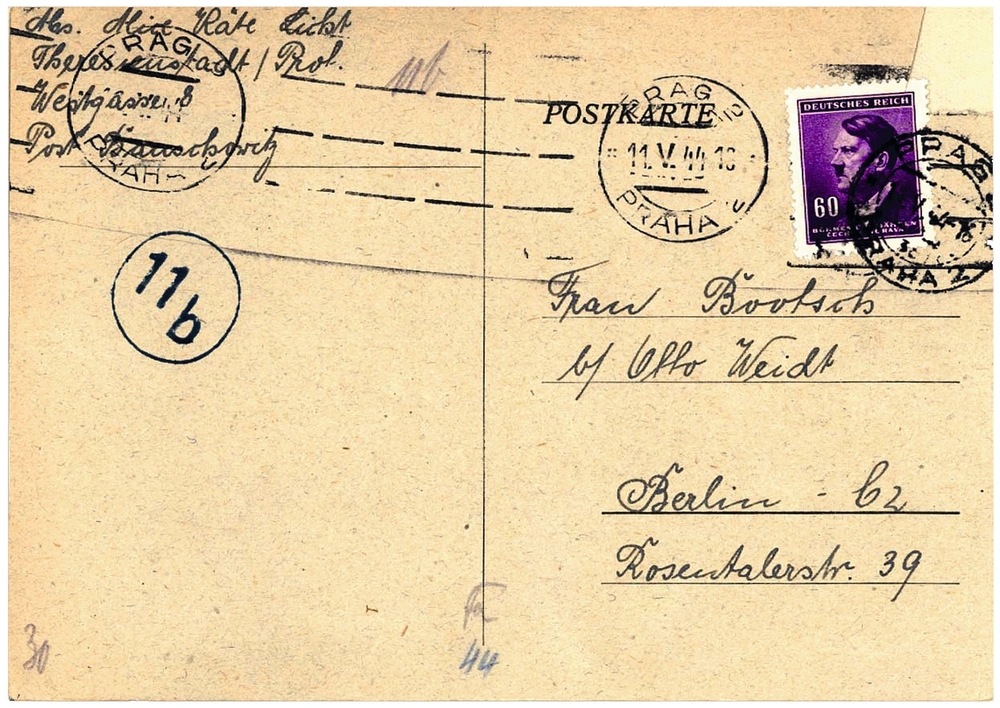
Alice Käte Licht to Bootsch c/o Otto Weidt, April 12, 1944Inhalt: Alice Licht confirms two packages from April 13 and one each from April 15 and 16, 1944, to a “Mrs. Bootsch” not known to us today. The date on the card is rather strange: April 12, 1944, actually before the receipt of the packages. Alice Licht presumably meant April 21 or 22. Alice Licht adds her mother’s first name Käthe to her own name as a greeting and sign of life. This censored card – the censor has left a “30” on the address side – was not postmarked until four weeks later, on May 11, 1944, at the post office in the Prague 2 district.Umschrift: Theresienstadt, April 12, 1944. My only ones, I hereby confirm the receipt of your package dated April 13 (2 packages), 15[,] 16, 1944. Your packages are all in our best possession. Please stay healthy and I send heartfelt kisses. Alice Käte Licht Signature. Source: Yad Vashem, Jerusalem