

Alice Licht
died 1986-10-30, Israel

Alice Licht, born in Berlin in 1916, had to leave school in 1933 without qualifying for university, as a Jew. That meant she could not study medicine as planned, and instead trained as a secretary. She had to perform heavy forced labor from the spring of 1941, but was able to achieve her dismissal by feigning a stomach ulcer. Otto Weidt gave her a position as a secretary in June 1941.
In February 1943 Otto Weidt hid Alice Licht and her parents Käte and Georg Licht in a storage room in Berlin-Mitte. When the workshop for the blind was betrayed in October 1943, the Gestapo arrested Alice Licht and others. Her parents then handed themselves in to the Gestapo. The family was deported to the Theresienstadt ghetto and six months later to Auschwitz-Birkenau extermination camp. Käthe and Georg Licht were murdered there. Alice Licht was transferred to the Christianstadt sub-camp of Groß-Rosen concentration camp. When this camp was closed at the end of January 1945, Alice Licht managed to escape from the death march. She experienced the end of the war in Otto and Else Weidt’s home in Berlin. Alice Licht died in Israel in 1986.
Dokumente
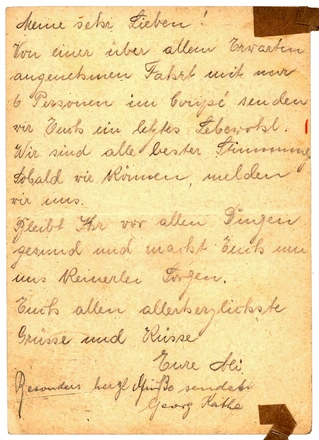

Alice Licht to the staff of Otto Weidt’s Workshop for the Blind, November 15, 1943Inhalt: On the way to Theresienstadt, Alice Licht wrote this card to Otto Weidt’s “fellowship.” She presumably threw it out of the train window, since deportees were not allowed to leave the train. The card was found and postmarked that same day in the village of Lobositz, seven kilometers from Theresienstadt. Alice Licht may have been surprised that they travelled in a third-class passenger car. This transport of 44 people on November 15, 1943 was one of the “small” deportation transports, for which the Reichsbahn railway connected either one or two passenger cars to scheduled trains departing Anhalter Bahnhof for Dresden and Prague. According to rumors in Berlin, the “old-age ghetto” Theresienstadt was thought to be more bearable than elsewhere. However, they did not yet know that paths led from the “better” Theresienstadt to the extermination camps.Umschrift: My dearly beloveds, We send you a last farewell from an unexpectedly pleasant journey with only 6 persons in a compartment. We are all in the best of spirits. We will contact you as soon as we can. Stay healthy above all, and don’t worry about us. Sending you all the most heartfelt wishes and kisses Your Ali Georg [and] Käthe send very best wishes” [written by Georg Licht] Source: Yad Vashem, Jerusalem

Alice Licht to the staff of Otto Weidt’s Workshop for the Blind, November 15, 1943Inhalt: On the way to Theresienstadt, Alice Licht wrote this card to Otto Weidt’s “fellowship.” She presumably threw it out of the train window, since deportees were not allowed to leave the train. The card was found and postmarked that same day in the village of Lobositz, seven kilometers from Theresienstadt. Alice Licht may have been surprised that they travelled in a third-class passenger car. This transport of 44 people on November 15, 1943 was one of the “small” deportation transports, for which the Reichsbahn railway connected either one or two passenger cars to scheduled trains departing Anhalter Bahnhof for Dresden and Prague. According to rumors in Berlin, the “old-age ghetto” Theresienstadt was thought to be more bearable than elsewhere. However, they did not yet know that paths led from the “better” Theresienstadt to the extermination camps.Umschrift: My dearly beloveds, We send you a last farewell from an unexpectedly pleasant journey with only 6 persons in a compartment. We are all in the best of spirits. We will contact you as soon as we can. Stay healthy above all, and don’t worry about us. Sending you all the most heartfelt wishes and kisses Your Ali Georg [and] Käthe send very best wishes” [written by Georg Licht] Source: Yad Vashem, Jerusalem


Alice Licht to Otto Weidt, January 6, 1944Inhalt: In this confirmation card, Alice Licht sends her thanks for four packages dated December 17, 25, 26, and 27, 1943. Otto Weidt had even made his way to one of the few post offices open during the Christmas holidays of 1943. His regular contacts with Theresienstadt, especially with Alice Licht, were obviously very important to him. By signing the card “Alice Käte Licht,” she was also sending greetings from her mother. This uncensored card was postmarked at Bauschowitz post office on January 12, 1944.Umschrift: Theresienstadt, January 6, 1944. Dearest friends, I confirm with thanks the receipt of your package dated December 17, 25, 26, 27, 1943. Käte Alice Licht. Source: Yad Vashem, Jerusalem

Alice Licht to Otto Weidt, January 6, 1944Inhalt: In this confirmation card, Alice Licht sends her thanks for four packages dated December 17, 25, 26, and 27, 1943. Otto Weidt had even made his way to one of the few post offices open during the Christmas holidays of 1943. His regular contacts with Theresienstadt, especially with Alice Licht, were obviously very important to him. By signing the card “Alice Käte Licht,” she was also sending greetings from her mother. This uncensored card was postmarked at Bauschowitz post office on January 12, 1944.Umschrift: Theresienstadt, January 6, 1944. Dearest friends, I confirm with thanks the receipt of your package dated December 17, 25, 26, 27, 1943. Käte Alice Licht. Source: Yad Vashem, Jerusalem


Alice Licht to Hedwig Porschütz, Workshop for the Blind, March 26, 1944Inhalt: From February 29, 1944, ghetto inmates were permitted to add short handwritten messages about the recipients of packages to package confirmation cards and to thank the senders. "With full contents” means nothing considered inappropriate was removed when the package was checked. Alice also asked for the correct postage of 60 pfennings, since packages then reached their recipients faster. The former sex worker and illegal trader Hedwig Porschütz was part of the circle of helpers formed around Otto Weidt. She was involved in several rescue campaigns, provided accommodation and food to persecuted Jews, and passed them on to other hiding places, including in her mother’s home in Berlin-Schöneberg.Umschrift: Theresienstadt, March 26, 1944. Dear Hede I confirm with thanks the receipt of your package dated February 22, February 23, February 24 February 27, March 9, March 10, 1944 All packages received with full contents and many thanks. Sending greetings to you all full of indescribable yearning. Please add 60 [pfennig] stamp and always note precise date of sending. Alice Käte Licht Signature. Source: Yad Vashem, Jerusalem

Alice Licht to Hedwig Porschütz, Workshop for the Blind, March 26, 1944Inhalt: From February 29, 1944, ghetto inmates were permitted to add short handwritten messages about the recipients of packages to package confirmation cards and to thank the senders. "With full contents” means nothing considered inappropriate was removed when the package was checked. Alice also asked for the correct postage of 60 pfennings, since packages then reached their recipients faster. The former sex worker and illegal trader Hedwig Porschütz was part of the circle of helpers formed around Otto Weidt. She was involved in several rescue campaigns, provided accommodation and food to persecuted Jews, and passed them on to other hiding places, including in her mother’s home in Berlin-Schöneberg.Umschrift: Theresienstadt, March 26, 1944. Dear Hede I confirm with thanks the receipt of your package dated February 22, February 23, February 24 February 27, March 9, March 10, 1944 All packages received with full contents and many thanks. Sending greetings to you all full of indescribable yearning. Please add 60 [pfennig] stamp and always note precise date of sending. Alice Käte Licht Signature. Source: Yad Vashem, Jerusalem


Alice Licht to the workshop staff, May 16, 1944Inhalt: On May 15, 1944, more than 2,500 people were deported from Theresienstadt to Auschwitz, among them Alice, Georg, and Käthe Licht, Erich and Elsbeth Frey, and Alice’s friend Marion Eisenstaedt. Using her previous method, Alice again threw this card out of the train window. It was found and placed in a mailbox in Pudlau in the Oderberg district of Upper Silesia on May 18, 1944. Erich and Elsbeth Frey were murdered soon after their arrival in Auschwitz. Eight weeks later, on July 15, 1944, Alice’s parents Georg and Käthe Licht fell victim to a selection. On the same day, Alice Licht and Marion Eisenstaedt were transferred as “capable of labor” to Christianstadt, an external sub-camp of Groß-Rosen concentration camp. They remained there until the camp was dissolved due to the Red Army’s advance in January 1945. They then managed to escape.Umschrift: Finder is politely asked to put card in the mailbox. Thank you Source: Yad Vashem, Jerusalem
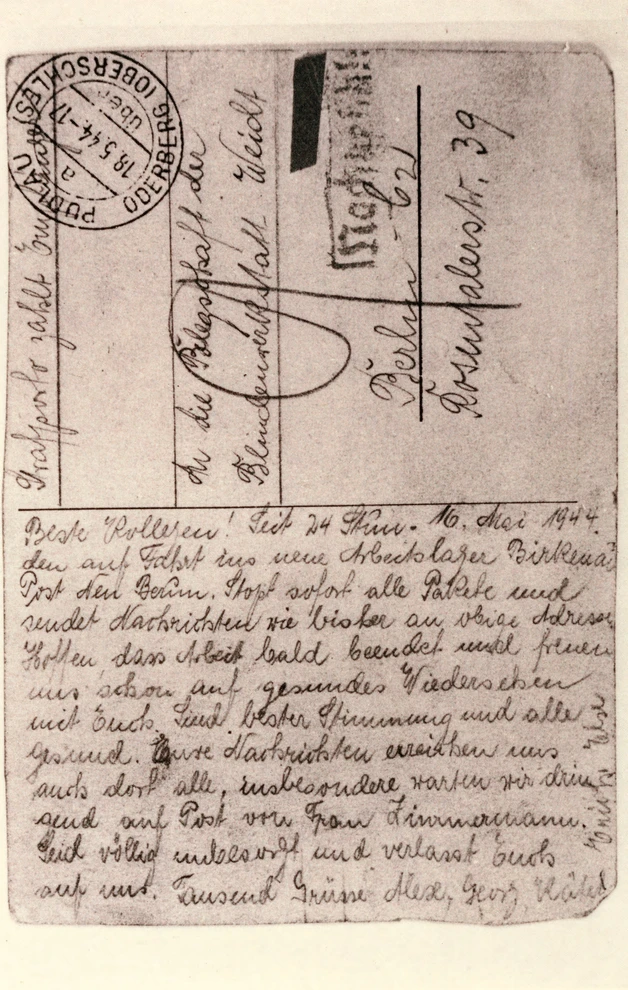
Alice Licht to the workshop staff, May 16, 1944Inhalt: On May 15, 1944, more than 2,500 people were deported from Theresienstadt to Auschwitz, among them Alice, Georg, and Käthe Licht, Erich and Elsbeth Frey, and Alice’s friend Marion Eisenstaedt. Using her previous method, Alice again threw this card out of the train window. It was found and placed in a mailbox in Pudlau in the Oderberg district of Upper Silesia on May 18, 1944. Erich and Elsbeth Frey were murdered soon after their arrival in Auschwitz. Eight weeks later, on July 15, 1944, Alice’s parents Georg and Käthe Licht fell victim to a selection. On the same day, Alice Licht and Marion Eisenstaedt were transferred as “capable of labor” to Christianstadt, an external sub-camp of Groß-Rosen concentration camp. They remained there until the camp was dissolved due to the Red Army’s advance in January 1945. They then managed to escape.Umschrift: Finder is politely asked to put card in the mailbox. Thank you Source: Yad Vashem, Jerusalem


Alice Licht-Roschwitz to Otto Weidt for Willy Latter, February 21, 1944Inhalt: The blind former concert pianist and music teacher Willy Latter was allocated to work in Otto Weidt’s Workshop for the Blind as a brush-maker in November 1942. He was married with two daughters. The National Socialists classed his marriage to a woman converted to Judaism as a “mixed marriage.” This status protected the family from deportation for a time. He was also able to continue working unregistered for Otto Weidt when he and his family were hiding with various acquaintances. The Latter family survived the National Socialist persecution and emigrated to the United States after the war. Willy Latter died at the age of 78 in 1974. We do not yet know to whom or what the name Roschwitz refers, under which Alice Licht sent her thanks to Willy Latter.Umschrift: Theresienstadt, February 21, 1944. Dear Willy, I confirm with thanks the receipt of your package dated December 1, 10 + January 20, 1944. Alice Licht-Roschwitz Signature. Source: Yad Vashem, Jerusalem

Alice Licht-Roschwitz to Otto Weidt for Willy Latter, February 21, 1944Inhalt: The blind former concert pianist and music teacher Willy Latter was allocated to work in Otto Weidt’s Workshop for the Blind as a brush-maker in November 1942. He was married with two daughters. The National Socialists classed his marriage to a woman converted to Judaism as a “mixed marriage.” This status protected the family from deportation for a time. He was also able to continue working unregistered for Otto Weidt when he and his family were hiding with various acquaintances. The Latter family survived the National Socialist persecution and emigrated to the United States after the war. Willy Latter died at the age of 78 in 1974. We do not yet know to whom or what the name Roschwitz refers, under which Alice Licht sent her thanks to Willy Latter.Umschrift: Theresienstadt, February 21, 1944. Dear Willy, I confirm with thanks the receipt of your package dated December 1, 10 + January 20, 1944. Alice Licht-Roschwitz Signature. Source: Yad Vashem, Jerusalem


Alice Licht, née Gundermann, to Karl Deibel, c/o Workshop for the Blind, April 18, 1944Inhalt: As sender, Alice Licht adds the maiden name of her grandmother Regina Gundermann, who died in Theresienstadt on January 28, 1944. She thanks Karl Deibel for two packages dated March 22, 1944. Born in 1897, the advertising clerk Karl Deibel began taking Jews in hiding and people persecuted for their politics into his home in 1942. He met Otto Weidt in 1943 at the latest. After most of the Jewish workers from the workshop for the blind were deported in 1943 and 1944, Karl Deibel joined the dispatch staff in the workshop. So as to shelter more people, Otto Weidt arranged for him to rent his former production premises at Großbeerenstraße 92 in Kreuzberg. Karl Deibel hid more than ten people there over time.Umschrift: Theresienstadt, April 18, 1944. Dearest friends I confirm with thanks the receipt of your package dated 2 x March 22, 1944. Alice Licht Signature. Source: Yad Vashem, Jerusalem

Alice Licht, née Gundermann, to Karl Deibel, c/o Workshop for the Blind, April 18, 1944Inhalt: As sender, Alice Licht adds the maiden name of her grandmother Regina Gundermann, who died in Theresienstadt on January 28, 1944. She thanks Karl Deibel for two packages dated March 22, 1944. Born in 1897, the advertising clerk Karl Deibel began taking Jews in hiding and people persecuted for their politics into his home in 1942. He met Otto Weidt in 1943 at the latest. After most of the Jewish workers from the workshop for the blind were deported in 1943 and 1944, Karl Deibel joined the dispatch staff in the workshop. So as to shelter more people, Otto Weidt arranged for him to rent his former production premises at Großbeerenstraße 92 in Kreuzberg. Karl Deibel hid more than ten people there over time.Umschrift: Theresienstadt, April 18, 1944. Dearest friends I confirm with thanks the receipt of your package dated 2 x March 22, 1944. Alice Licht Signature. Source: Yad Vashem, Jerusalem
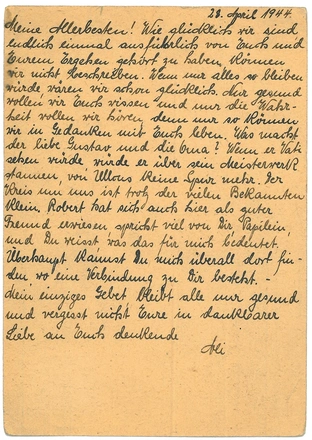

Alice Licht to Dr. Gustav Held, April 28, 1944Inhalt: Alice Licht used her quarterly writing permission to inform Inge and Gustav Held of the Licht family’s health. However, the main addressee is Otto Weidt, whom she asks not to hold back with the truth, presumably about the state of his health. She shares her feelings for him once again, tied to her wish not to be forgotten – as if sensing what was to come. Written on April 28, this card is postmarked with the date of June 6, 1944. By the time Otto Weidt received the card, the Licht family had been in Auschwitz-Birkenau for three weeks. Otto Weidt was aware of this. He traveled to Auschwitz to offer his brush products and attempted to make contact to Alice Licht. He did not succeed.Umschrift: April 28, 1944 My very best ones, we can’t describe how happy we are to have heard at last in detail from you and how you are. If only everything were to stay that way, we would be happy enough. All we want is to know you are all healthy and to hear the truth, for only in that way can we live with you in our thoughts. How are dear Gustav and Grandma? If he were to see Dad he would be amazed at his masterpiece, not a trace left of his ulcer. The circle around us is small, despite our many acquaintances. Robert has proved a good friend here too, speaks often of you, little Pappi, and you know what that means for me. In fact, you can always find me where there is a connection to you. My only prayer, please all stay healthy and don’t forget me, thinking of you in grateful love, your Ali Source: Stiftung Neue Synagoge Berlin – Centrum Judaicum

Alice Licht to Dr. Gustav Held, April 28, 1944Inhalt: Alice Licht used her quarterly writing permission to inform Inge and Gustav Held of the Licht family’s health. However, the main addressee is Otto Weidt, whom she asks not to hold back with the truth, presumably about the state of his health. She shares her feelings for him once again, tied to her wish not to be forgotten – as if sensing what was to come. Written on April 28, this card is postmarked with the date of June 6, 1944. By the time Otto Weidt received the card, the Licht family had been in Auschwitz-Birkenau for three weeks. Otto Weidt was aware of this. He traveled to Auschwitz to offer his brush products and attempted to make contact to Alice Licht. He did not succeed.Umschrift: April 28, 1944 My very best ones, we can’t describe how happy we are to have heard at last in detail from you and how you are. If only everything were to stay that way, we would be happy enough. All we want is to know you are all healthy and to hear the truth, for only in that way can we live with you in our thoughts. How are dear Gustav and Grandma? If he were to see Dad he would be amazed at his masterpiece, not a trace left of his ulcer. The circle around us is small, despite our many acquaintances. Robert has proved a good friend here too, speaks often of you, little Pappi, and you know what that means for me. In fact, you can always find me where there is a connection to you. My only prayer, please all stay healthy and don’t forget me, thinking of you in grateful love, your Ali Source: Stiftung Neue Synagoge Berlin – Centrum Judaicum