

Werner Basch
died 1945-01-19, Kaufering/Dachau concentration camp

Werner Basch was born in Berlin on May 16, 1908. In 1939 he lived in Berlin-Schöneberg with his wife Ilse, née Caro, and his mother Hulda Basch. The “Deployment Section for Jews” at Berlin’s Labor Office placed him as a forced laborer in Otto Weidt’s Workshop for the Blind, where he worked from 1941. Although Jews were banned from performing office duties, Otto Weidt employed him as a bookkeeper. Ilse Basch worked for the Jewish Community.
Werner and Ilse Basch were deported to the Theresienstadt ghetto on June 17, 1943. Hulda Basch had been imprisoned there for the previous eight months. Otto Weidt sent the family several food packages. Hulda Basch died in Theresienstadt at the age of 70 in April 1944. On September 29, 1944, Werner Basch was deported to Auschwitz-Birkenau extermination camp, followed by his wife Ilse a month later. Werner Basch was transferred to Dachau concentration camp on October 10, 1944, and perished in the Kaufering sub-camp on January 19, 1945. His wife Ilse was murdered in Auschwitz-Birkenau.
Dokumente


Werner Basch to the Workshop for the Blind, February 3, 1944Inhalt: On the same day Werner Basch used his permission to write a “normal” card to ask his “Uncle Otto” whether he had forgotten him, Otto Weidt sent a package for him. In return, he received a package confirmation card franked with a 30-heller postage stamp at the post office in Bauschowitz and postmarked February 18, 1944, two weeks after it was written.Umschrift: Theresienstadt, February 3, 1944. Dear friends, I confirm with thanks the receipt of your package dated January 20, 1944. Werner Basch Signature. Source: Yad Vashem, Jerusalem

Werner Basch to the Workshop for the Blind, February 3, 1944Inhalt: On the same day Werner Basch used his permission to write a “normal” card to ask his “Uncle Otto” whether he had forgotten him, Otto Weidt sent a package for him. In return, he received a package confirmation card franked with a 30-heller postage stamp at the post office in Bauschowitz and postmarked February 18, 1944, two weeks after it was written.Umschrift: Theresienstadt, February 3, 1944. Dear friends, I confirm with thanks the receipt of your package dated January 20, 1944. Werner Basch Signature. Source: Yad Vashem, Jerusalem


Werner Basch to the Workshop for the Blind, October 14, 1943Inhalt: Born in Berlin in 1908, Werner Basch worked at Otto Weidt’s Workshop for the Blind from 1941. Although Jews were banned from performing office work, Weidt employed him as a bookkeeper. That is why he uses the rather old-fashioned “Titl.” as an abbreviation for “Titulierung” or “title,” as a kind of summary when it is not known which form of address is correct. On June 16, 1943, Werner and Ilse Basch were deported to the Theresienstadt ghetto along with many Jewish Community employees. The transport was made up of around 430 people. Werner Basch was transferred to Auschwitz on September 19, 1944, followed by his wife Ilse Basch four weeks later. Classed as “capable of labor,” he was sent from Auschwitz to Dachau concentration camp. He perished in Kaufering subcamp on January 19, 1945.Umschrift: Theresienstadt, October 14, 1943. Dear friends, I confirm with thanks the receipt of your [3] package dated October 1943. Letter to follow. Werner Basch Signature. Source: Yad Vashem, Jerusalem

Werner Basch to the Workshop for the Blind, October 14, 1943Inhalt: Born in Berlin in 1908, Werner Basch worked at Otto Weidt’s Workshop for the Blind from 1941. Although Jews were banned from performing office work, Weidt employed him as a bookkeeper. That is why he uses the rather old-fashioned “Titl.” as an abbreviation for “Titulierung” or “title,” as a kind of summary when it is not known which form of address is correct. On June 16, 1943, Werner and Ilse Basch were deported to the Theresienstadt ghetto along with many Jewish Community employees. The transport was made up of around 430 people. Werner Basch was transferred to Auschwitz on September 19, 1944, followed by his wife Ilse Basch four weeks later. Classed as “capable of labor,” he was sent from Auschwitz to Dachau concentration camp. He perished in Kaufering subcamp on January 19, 1945.Umschrift: Theresienstadt, October 14, 1943. Dear friends, I confirm with thanks the receipt of your [3] package dated October 1943. Letter to follow. Werner Basch Signature. Source: Yad Vashem, Jerusalem


Werner Basch to Otto Weidt, December 30, 1943Inhalt: With this card written on the second-last day of 1943, Werner Basch confirms a package sent from Berlin by Otto Weidt on December 15. At this point, 34,655 prisoners were living in the Theresienstadt ghetto, including almost 3,400 children. This card was given a 30-heller postage stamp at the Bauschowitz post office. The date of the postmark is January 13, 1944.Umschrift: Theresienstadt, December 30, 1943. Dear Uncle Otto, I confirm with thanks the receipt of your package dated December 15, 1943. Werner Basch Signature.

Werner Basch to Otto Weidt, December 30, 1943Inhalt: With this card written on the second-last day of 1943, Werner Basch confirms a package sent from Berlin by Otto Weidt on December 15. At this point, 34,655 prisoners were living in the Theresienstadt ghetto, including almost 3,400 children. This card was given a 30-heller postage stamp at the Bauschowitz post office. The date of the postmark is January 13, 1944.Umschrift: Theresienstadt, December 30, 1943. Dear Uncle Otto, I confirm with thanks the receipt of your package dated December 15, 1943. Werner Basch Signature.


Werner Basch to Otto Weidt, January 20, 1944Inhalt: From May 1943, prisoners were only allowed to send one postcard every three months. Due to the increased number of prisoners, the postcards were issued by the block elders or building elders. Werner Basch, who uses the “uncle-nephew” connection here only for appearances, used his permission to write in January 1944 to ask Otto Weidt emphatically for packages. His comment that he had not heard from him for months may be true, since the last known confirmation card is dated December 30, 1943. This postcard was censored, as evidenced by the penciled “26” on the bottom left of the back. It arrived in Berlin at the Reich Association of Jews in Germany, which franked it and stamped it “Return answer on postcards in German language only.” A staff member posted it in the Berlin-Charlottenburg 2 district.Umschrift: Theresienstadt, January 20, 1944. Dear Uncle Otto, I trust you are in receipt of my various cards and can inform you with these lines that my family and I are healthy, which I hope also goes for you. Sadly, I have not heard from you for months, while I know that Ali regularly receives post from you. I am very distressed by this fact, since I can think of no reason why you have forgotten me entirely, or is the mail to Ali and family always intended for me too? In any case, I would be very pleased to hear directly from you instead, as far as your time and worries allow. For today, I remain with heartfelt regards from us all Your nephew Werner Basch Source: Yad Vashem, Jerusalem

Werner Basch to Otto Weidt, January 20, 1944Inhalt: From May 1943, prisoners were only allowed to send one postcard every three months. Due to the increased number of prisoners, the postcards were issued by the block elders or building elders. Werner Basch, who uses the “uncle-nephew” connection here only for appearances, used his permission to write in January 1944 to ask Otto Weidt emphatically for packages. His comment that he had not heard from him for months may be true, since the last known confirmation card is dated December 30, 1943. This postcard was censored, as evidenced by the penciled “26” on the bottom left of the back. It arrived in Berlin at the Reich Association of Jews in Germany, which franked it and stamped it “Return answer on postcards in German language only.” A staff member posted it in the Berlin-Charlottenburg 2 district.Umschrift: Theresienstadt, January 20, 1944. Dear Uncle Otto, I trust you are in receipt of my various cards and can inform you with these lines that my family and I are healthy, which I hope also goes for you. Sadly, I have not heard from you for months, while I know that Ali regularly receives post from you. I am very distressed by this fact, since I can think of no reason why you have forgotten me entirely, or is the mail to Ali and family always intended for me too? In any case, I would be very pleased to hear directly from you instead, as far as your time and worries allow. For today, I remain with heartfelt regards from us all Your nephew Werner Basch Source: Yad Vashem, Jerusalem


Werner Basch to the Workshop for the Blind, March 26, 1944Inhalt: On March 26, 1944, Werner Basch confirms the receipt of three packages sent from Berlin on March 2, 8, and 12. From February 29, 1944, prisoners were again permitted to add short handwritten messages to the recipients of confirmation cards, and to thank the senders for their packages. This uncensored card was franked with 60 hellers by the Council of Jewish Elders in Prague and postmarked in Prague on April 6, 1944. The round “11 b” stamp refers to the zip code area containing the ghetto.Umschrift: Theresienstadt, March 26, 1944. Dear friends, I confirm with thanks the receipt of your package dated March 2, 8, 12, 1944. Heartfelt thanks for sign of life awaited with longing and I hope for further news soon. Werner Basch Signature. Source: Yad Vashem, Jerusalem

Werner Basch to the Workshop for the Blind, March 26, 1944Inhalt: On March 26, 1944, Werner Basch confirms the receipt of three packages sent from Berlin on March 2, 8, and 12. From February 29, 1944, prisoners were again permitted to add short handwritten messages to the recipients of confirmation cards, and to thank the senders for their packages. This uncensored card was franked with 60 hellers by the Council of Jewish Elders in Prague and postmarked in Prague on April 6, 1944. The round “11 b” stamp refers to the zip code area containing the ghetto.Umschrift: Theresienstadt, March 26, 1944. Dear friends, I confirm with thanks the receipt of your package dated March 2, 8, 12, 1944. Heartfelt thanks for sign of life awaited with longing and I hope for further news soon. Werner Basch Signature. Source: Yad Vashem, Jerusalem


Werner Basch to the Workshop for the Blind, May 3, 1944Inhalt: Werner Basch confirms a package sent in Berlin on April 19, 1944. His handwriting in the note is not as concentrated as usual. This may be due to the death of his mother Hulda Basch in the Theresienstadt ghetto nine days previously, on April 26, 1944. She lived only to the age of 61. It is almost impossible to imagine what it must have been like to watch one’s nearest relatives perish from the appalling living conditions and barely treated diseases in the ghetto. This card appears to have been checked by two censors, as evidenced by the penciled “46” on the bottom left of the back, and the additional initials “Pa” or “Fa” at the bottom of the dividing line. On June 8, 1944, a month after the card was written, a staff member at the Council of Jewish Elders franked it in Prague. It was postmarked at the Prague 2 post office.Umschrift: Theresienstadt, May 3, 1944. Dear friends, I confirm with thanks the receipt of your package dated April 19, 1944. Extremely pleased by your mail, we thank you with heartfelt regards. Werner Basch Signature. Source: Yad Vashem, Jerusalem

Werner Basch to the Workshop for the Blind, May 3, 1944Inhalt: Werner Basch confirms a package sent in Berlin on April 19, 1944. His handwriting in the note is not as concentrated as usual. This may be due to the death of his mother Hulda Basch in the Theresienstadt ghetto nine days previously, on April 26, 1944. She lived only to the age of 61. It is almost impossible to imagine what it must have been like to watch one’s nearest relatives perish from the appalling living conditions and barely treated diseases in the ghetto. This card appears to have been checked by two censors, as evidenced by the penciled “46” on the bottom left of the back, and the additional initials “Pa” or “Fa” at the bottom of the dividing line. On June 8, 1944, a month after the card was written, a staff member at the Council of Jewish Elders franked it in Prague. It was postmarked at the Prague 2 post office.Umschrift: Theresienstadt, May 3, 1944. Dear friends, I confirm with thanks the receipt of your package dated April 19, 1944. Extremely pleased by your mail, we thank you with heartfelt regards. Werner Basch Signature. Source: Yad Vashem, Jerusalem
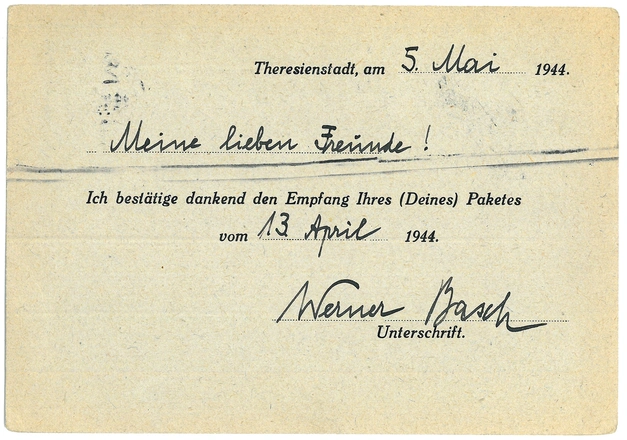

Werner Basch to the Workshop for the Blind, May 5, 1944Inhalt: This card, confirming the arrival of a package mailed on April 13, 1944, has been censored, evidenced by the initials “Pa” or “Fa” on the back. It was sent by courier to the Council of Jewish Elders in Prague, where it was franked with a 30-heller postage stamp. The date of the postmark used in the Prague 2 post office is illegible.Umschrift: Theresienstadt, May 5, 1944. My dear friends, I hereby confirm with thanks the receipt of your package dated April 13, 1944. Werner Basch Signature. Source: Yad Vashem, Jerusalem

Werner Basch to the Workshop for the Blind, May 5, 1944Inhalt: This card, confirming the arrival of a package mailed on April 13, 1944, has been censored, evidenced by the initials “Pa” or “Fa” on the back. It was sent by courier to the Council of Jewish Elders in Prague, where it was franked with a 30-heller postage stamp. The date of the postmark used in the Prague 2 post office is illegible.Umschrift: Theresienstadt, May 5, 1944. My dear friends, I hereby confirm with thanks the receipt of your package dated April 13, 1944. Werner Basch Signature. Source: Yad Vashem, Jerusalem
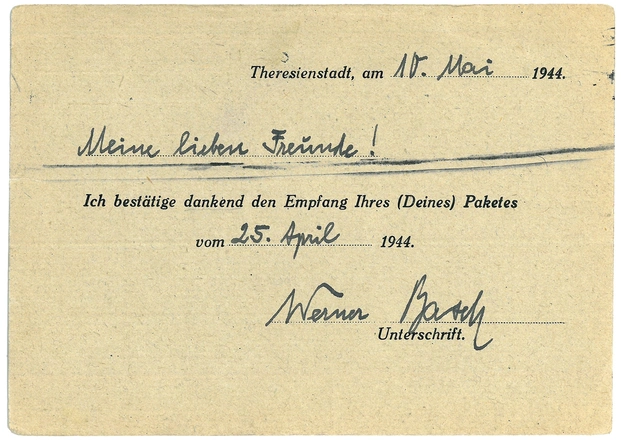

Werner Basch to the Workshop for the Blind, May 10, 1944Inhalt: Werner Basch confirms the arrival of another package, sent from Berlin on April 25, 1944. The card was checked by a different censor this time. The initials on the back of the card appear to be “Le.” The card found its way to Berlin via the Council of Jewish Elders in Prague, where it was franked with a 30-heller postage stamp. The date of the postmark received at the post office in Prague 2 is illegible. The round “11 b” stamp once again refers to the zip code area containing the ghetto.Umschrift: Theresienstadt, May 10, 1944. My dear friends, I confirm with thanks the receipt of your package dated April 25, 1944 Werner Basch Signature. Source: Yad Vashem, Jerusalem

Werner Basch to the Workshop for the Blind, May 10, 1944Inhalt: Werner Basch confirms the arrival of another package, sent from Berlin on April 25, 1944. The card was checked by a different censor this time. The initials on the back of the card appear to be “Le.” The card found its way to Berlin via the Council of Jewish Elders in Prague, where it was franked with a 30-heller postage stamp. The date of the postmark received at the post office in Prague 2 is illegible. The round “11 b” stamp once again refers to the zip code area containing the ghetto.Umschrift: Theresienstadt, May 10, 1944. My dear friends, I confirm with thanks the receipt of your package dated April 25, 1944 Werner Basch Signature. Source: Yad Vashem, Jerusalem


Werner Basch to Weidt-Latter’s Workshop for the Blind, May 19, 1944Inhalt: Werner Basch uses a slightly different address here for the first time, “Weidt-Latter.” This combination of the names Otto Weidt and Willy Latter appears in cards from several Theresienstadt prisoners who received “gift of love packages” from Otto Weidt. Willy Latter, a concert pianist, music teacher, and shorthand typist, went blind at the age of thirteen and began his working life as a commercial assistant. He married a woman who converted to Judaism, which the National Socialists classed as a “mixed marriage,” initially protecting the family from deportation. In November 1942, Willy Latter was allocated to Otto Weidt’s Workshop for the Blind. He was able to go on working there, unregistered, when he and his family were hiding with various acquaintances. Willy, his wife Margarethe Latter, and their daughters Lilian and Marianne survived the National Socialist persecution and emigrated to the United States after the war. Willy Latter died at the age of 78 in 1974. Four days before this package confirmation card was written, Alice, Georg, and Käthe Licht, and Erich Magnus and Elsbeth Frey had been deported to Auschwitz. Werner Basch was not permitted to mention this, however.Umschrift: Theresienstadt, May 19, 1944. May 19, 1944 Dear friends, I confirm with thanks the arrival of your package dated May 2, 1944. Werner Basch Signature. Source: Yad Vashem, Jerusalem

Werner Basch to Weidt-Latter’s Workshop for the Blind, May 19, 1944Inhalt: Werner Basch uses a slightly different address here for the first time, “Weidt-Latter.” This combination of the names Otto Weidt and Willy Latter appears in cards from several Theresienstadt prisoners who received “gift of love packages” from Otto Weidt. Willy Latter, a concert pianist, music teacher, and shorthand typist, went blind at the age of thirteen and began his working life as a commercial assistant. He married a woman who converted to Judaism, which the National Socialists classed as a “mixed marriage,” initially protecting the family from deportation. In November 1942, Willy Latter was allocated to Otto Weidt’s Workshop for the Blind. He was able to go on working there, unregistered, when he and his family were hiding with various acquaintances. Willy, his wife Margarethe Latter, and their daughters Lilian and Marianne survived the National Socialist persecution and emigrated to the United States after the war. Willy Latter died at the age of 78 in 1974. Four days before this package confirmation card was written, Alice, Georg, and Käthe Licht, and Erich Magnus and Elsbeth Frey had been deported to Auschwitz. Werner Basch was not permitted to mention this, however.Umschrift: Theresienstadt, May 19, 1944. May 19, 1944 Dear friends, I confirm with thanks the arrival of your package dated May 2, 1944. Werner Basch Signature. Source: Yad Vashem, Jerusalem


Werner Basch to Otto Weidt’s Workshop for the Blind, June 20, 1944Inhalt: Werner Basch confirms a package sent from Berlin three days previously, on June 17, 1944. It is obvious that his handwriting has changed. This censored card, as evidenced by the initials “Fa” at the bottom of the dividing line on the back, was franked with a 60-heller postage stamp for long-distance mail by the staff of the Council of Jewish Elders in Prague. It was postmarked at the post office in Prague 25 on July 8, 1944, almost four weeks later.Umschrift: Theresienstadt, June 20, 1944. Dear friends I confirm with thanks the receipt of your package dated June 17, 1944. Werner Basch Signature. Source: Yad Vashem, Jerusalem

Werner Basch to Otto Weidt’s Workshop for the Blind, June 20, 1944Inhalt: Werner Basch confirms a package sent from Berlin three days previously, on June 17, 1944. It is obvious that his handwriting has changed. This censored card, as evidenced by the initials “Fa” at the bottom of the dividing line on the back, was franked with a 60-heller postage stamp for long-distance mail by the staff of the Council of Jewish Elders in Prague. It was postmarked at the post office in Prague 25 on July 8, 1944, almost four weeks later.Umschrift: Theresienstadt, June 20, 1944. Dear friends I confirm with thanks the receipt of your package dated June 17, 1944. Werner Basch Signature. Source: Yad Vashem, Jerusalem


Werner Basch to Otto Weidt’s Workshop for the Blind, August 30, 1944Inhalt: No packages from Otto Weidt reached the Theresienstadt ghetto in July 1944. The only surviving message is a postcard from Anna Peretz to the Helds with the note: “...we have good cooking facilities...” After a long break from June 17 to August 10, 1944, Werner and Ilse Basch, Ilse-Jenny Cohn, the blind Irma Lessner, Richard Rockmann, and Bernhard Wohlgemuth again received a total of seven packages of food and other essentials from Berlin. This card, not censored, was again franked with a 60-heller postage stamp for long-distance mail by the Council of Jewish Elders in Prague, and postmarked in Prague on September 22, 1944, four weeks later.Umschrift: Theresienstadt, August 30, 1944. Dear friends, I confirm with thanks the receipt of your package dated August 10, 1944. Werner Basch Signature. Source: Yad Vashem, Jerusalem

Werner Basch to Otto Weidt’s Workshop for the Blind, August 30, 1944Inhalt: No packages from Otto Weidt reached the Theresienstadt ghetto in July 1944. The only surviving message is a postcard from Anna Peretz to the Helds with the note: “...we have good cooking facilities...” After a long break from June 17 to August 10, 1944, Werner and Ilse Basch, Ilse-Jenny Cohn, the blind Irma Lessner, Richard Rockmann, and Bernhard Wohlgemuth again received a total of seven packages of food and other essentials from Berlin. This card, not censored, was again franked with a 60-heller postage stamp for long-distance mail by the Council of Jewish Elders in Prague, and postmarked in Prague on September 22, 1944, four weeks later.Umschrift: Theresienstadt, August 30, 1944. Dear friends, I confirm with thanks the receipt of your package dated August 10, 1944. Werner Basch Signature. Source: Yad Vashem, Jerusalem


Werner Basch to Otto Latter, September 14, 1944Inhalt: This last postcard from Werner Basch is addressed to Otto Latter—a combination of the names Otto Weidt and Willy Latter. By the time Otto Weidt received this card, postmarked on October 30, 1944, six weeks after it was written, Ilse Basch was no longer alive. She was transferred from Theresienstadt to Auschwitz on October 23. Werner Basch, who had been deported to Auschwitz on September 29, 1944, four weeks before his wife, was already in Dachau concentration camp. He died in Kaufering subcamp on January 19, 1945. It is not clear why Werner Basch asked after “Ali” (Alice Licht), who had been deported to Auschwitz in May. Did he assume Otto Weidt could find her in Auschwitz and possibly get her out?Umschrift: Theresienstadt, Sept. 14, 1944. Dear Uncle Otto, I trust you are in receipt of our most recent cards and hope you are well, which I can report of ourselves. We were very pleased again by your last package sent in August. I would like to take this opportunity to point out the altered regulations for postal correspondence with us. You can now write to us only every four weeks, and only via the Reich Association, N 65, Schulstr. 78, while we can only write to you every 8 weeks in future. Packages, however, will be transferred directly as previously and always arrive here quickly and in good condition. How are Ali and family? We would be very glad to continue hearing from you regularly and for today I remain with many affectionate regards from us all. Your grateful nephew, Werner Basch Source: Yad Vashem, Jerusalem

Werner Basch to Otto Latter, September 14, 1944Inhalt: This last postcard from Werner Basch is addressed to Otto Latter—a combination of the names Otto Weidt and Willy Latter. By the time Otto Weidt received this card, postmarked on October 30, 1944, six weeks after it was written, Ilse Basch was no longer alive. She was transferred from Theresienstadt to Auschwitz on October 23. Werner Basch, who had been deported to Auschwitz on September 29, 1944, four weeks before his wife, was already in Dachau concentration camp. He died in Kaufering subcamp on January 19, 1945. It is not clear why Werner Basch asked after “Ali” (Alice Licht), who had been deported to Auschwitz in May. Did he assume Otto Weidt could find her in Auschwitz and possibly get her out?Umschrift: Theresienstadt, Sept. 14, 1944. Dear Uncle Otto, I trust you are in receipt of our most recent cards and hope you are well, which I can report of ourselves. We were very pleased again by your last package sent in August. I would like to take this opportunity to point out the altered regulations for postal correspondence with us. You can now write to us only every four weeks, and only via the Reich Association, N 65, Schulstr. 78, while we can only write to you every 8 weeks in future. Packages, however, will be transferred directly as previously and always arrive here quickly and in good condition. How are Ali and family? We would be very glad to continue hearing from you regularly and for today I remain with many affectionate regards from us all. Your grateful nephew, Werner Basch Source: Yad Vashem, Jerusalem